https://norfolkislandandfirstfleetersandfamilies.blogspot.com
James Morrisby and Ann (Lavender) Brooks timeline
 |
| James Morrisby 1756-1839 |
James Morrisby was born in Yorkshire 23
January 1756 and died 29 May 1839 in Clarence Plains Tasmania.
7 July 1784 James
Morrisby (No.10482) was convicted at Old Bailey, London for Felony
(stealing a 10lb iron bar valued at 10 pence) and received 7 years
transportation. James was a Blacksmith and stated that he had served about 10
years in the Guards and that he had a wife and five children! (A James Morrisby from Cawood had enlisted in the Scots Guards on 3 April 1776 aged 19, 5ft 7ins tall and had brown eyes).
James did in fact have a wife Mary Donaldson born 1760 in England. They married 20 November 1782 in England and had a daughter Catherine Dorcas Morrisby born 11 March 1784 in England and christened 30 March 1784 at St Sepulchre, London. Catherine was only 4 months old when her father was convicted. Catherine Morrisby married William Alexander Davison born 1780 in England on 25 October 1807 at Saint James Dukes Place, London.
James did in fact have a wife Mary Donaldson born 1760 in England. They married 20 November 1782 in England and had a daughter Catherine Dorcas Morrisby born 11 March 1784 in England and christened 30 March 1784 at St Sepulchre, London. Catherine was only 4 months old when her father was convicted. Catherine Morrisby married William Alexander Davison born 1780 in England on 25 October 1807 at Saint James Dukes Place, London.
6 September 1784 James
was put on the “Censor” Prisoner Hulk in London and was later transferred to
“Scarborough” to be transported to Australia.
13 May 1787 James
departed Portsmouth, England on “
Scarborough” as a First Fleet
convict, spending 251 days at sea before arriving on 19 January 1788 in Port Jackson, Sydney Cove, Australia.
4 March 1790 James was transferred to Norfolk Island aboard
"Sirius", along with 116 male convicts, 67 female convicts, 27
infants, 65 marines and 5 marine wives.
13 March 1790 Ships "Sirius" & "Supply"
arrived at Cascade Bay on the north side of the island in foul weather. Some of
those on Norfolk Island thought they were witnessing the arrival of the second
fleet. This was soon dispelled when nearly two hundred convicts were off
loaded. Together with the convicts was a small army detachment under the
command of Major Robert Ross.
15
March 1790 all those on board "Sirius" were off loaded and safe. Captain Hunter
tried to anchor on the south side of the Island. 19 March 1790 "Sirius" while still anchored in Sydney Bay, struck rocks and broke up. The wreck of "Sirius" meant that the
colony now had only one small leaky vessel between it and possible death from
starvation.
Meanwhile Ann Brooks, born 1765 in England and died 1813 in Hobart, Tasmania had arrived on Norfolk Island. It seems Ann was born into the Lavender family and married William Brooks who ended up in gaol, transported to Africa and father of William Brooks born 1786 in England.
Meanwhile Ann Brooks, born 1765 in England and died 1813 in Hobart, Tasmania had arrived on Norfolk Island. It seems Ann was born into the Lavender family and married William Brooks who ended up in gaol, transported to Africa and father of William Brooks born 1786 in England.
Ann Brooks was living in a Court off Parker Lane. She was supporting a small child by dealing old clothes at the rag fair. 12 December 1787 Ann (No.10827) was convicted in Middlesex, London for Burglary (stealing pair of bedsheets from a room in Drury Lane to sell to support her son William), and received 7 years transportation at age 25. Ann spent 15 months in Newgate Gaol.
The "Lady Juliana" lay in the River Thames for 6 months while the gaols were emptied and the women placed on board. 29 July 1789 Ann departed Plymouth, England on "Lady Juliana" with 2 year old William Brooks. It was the 1st female convict ship to leave England, (known as the "floating brothel"), and the first sailing of any convict ship after the "First Fleet" sailed in May 1787. "Lady Juliana" left Portsmouth 6 months before the "Second Fleet" left on 19 January 1790, yet arrived in Port Jackson less than a month before the "Second Fleet" arrived on 28 June 1790. "Lady Juliana" was officially considered a "Second Fleeter".
3 June 1790 Ann Brooks arrived in Port Jackson with her son William, 301 days later and journeyed 13,000 miles.
3 June 1790 Ann Brooks arrived in Port Jackson with her son William, 301 days later and journeyed 13,000 miles.
1 August 1790 Ann Brooks and son William were transferred to Norfolk Island on "Surprise", along with 194 convicts, arriving 7 August 1790.
25 April 1791 Ann Brooks gave birth to a son named Richard Brooks Larsom on Norfolk Island. The father was Richard Larsom, a crew member on "Lady Juliana. (Refer to Richard Larsom & Ann Whiting Kidner Blog)
July 1791 James Morrisby was living on a Sydney town lot on Norfolk
Island and sharing a sow with Ann Brooks (also known as Ann Lavender), and her
son William who was transported aboard the "Lady Juliana" with his
mother as part of the "2nd Fleet".
5 November 1791 James Morrisby and Ann (Lavender) Brooks were married by Rev Richard Johnson. James took on the responsibility of a wife with two small boys, William Brooks and Richard Larsom.
5 November 1791 James Morrisby and Ann (Lavender) Brooks were married by Rev Richard Johnson. James took on the responsibility of a wife with two small boys, William Brooks and Richard Larsom.
December 1791 James and Ann occupied 12 acres at Mt.Pitt Path (Lot No.57). This had increased to 34 acres by 1796 “Settler’s
Blocks on Norfolk Island in 1796” records that James Morrisby had 24 acres
Parcel No.61 & 20 acres Parcel No.57. (Refer to Settlers Lot on Norfolk Island in 1796 Blog).
25 December 1807 James Morrisby and wife Ann Brooks and
their 5 children born between 1791 and 1805 (Grace, George, Dinah, Henry and
John) embarked on the "Porpoise"
for Van Diemen's Land as part of the demise of the first Norfolk Island
settlement. It is recorded that they
left behind 55 acres of land, 14 of which were sown in grain, 10 in pasture and
the rest fallow. They owned 7 hogs and
held 200 bushels of maize in store.
Their buildings were valued at 90 Pounds included a house 12ft x 26ft,
boarded floor and shingle roof, 2 floored barns and 1 outhouse. They
arrived 17 January 1808 and were granted 80 acres Parcel No.4 at Clarence Plains (now Rokeby) in Tasmania.
2 February 1813 Ann died in
Hobart and was buried at St David’s Park.
There has been a variety of explanations about the name of Ann Lavender Brooks. I have come to the view that she was born into the family of Lavender. She began her life of thieving at the age of 16. She changed her name to Ann Brooks when she became associated/married to a William Brooks who was the father of her son William Brooks. He was a criminal, transported to Africa and was never heard of again. The fact that Lavender has been fondly used as a christian name in the next few generations also indicates to me that it was Ann's maiden name. It seems that the female convicts often kept their maiden names even if they married.
18 November 1816 James Morrisby married Eleanor Murphy in Hobart. Eleanor was also a Convict. She arrived at Port Jackson on "Catherine" on 4 May 1814. Eleanor died on 14 February 1821.
There has been a variety of explanations about the name of Ann Lavender Brooks. I have come to the view that she was born into the family of Lavender. She began her life of thieving at the age of 16. She changed her name to Ann Brooks when she became associated/married to a William Brooks who was the father of her son William Brooks. He was a criminal, transported to Africa and was never heard of again. The fact that Lavender has been fondly used as a christian name in the next few generations also indicates to me that it was Ann's maiden name. It seems that the female convicts often kept their maiden names even if they married.
18 November 1816 James Morrisby married Eleanor Murphy in Hobart. Eleanor was also a Convict. She arrived at Port Jackson on "Catherine" on 4 May 1814. Eleanor died on 14 February 1821.
I817 James Morrisby's activities as a Constable were noted in a newspaper,
when he assisted Sergeant McCartny in capturing some bushrangers. The paper
noted that the Governor acknowledged the good disposition and sport which he
would not fail to bear in mind, of the example of settlers in general in these
matters. James advertised best quality
salt for sale in Collins St for 5d a pound. His trade was Blacksmith,
Guardsman, Constable, Crewman, Land holder.
George James Morrisby (14 November 1826)
Accident – on Tuesday evening, a young man named George Morrisby while returning from town to his farm at Clarence Plains with a cart and four bullocks, met with a most fatal accident. It appears that there was another cart ahead of him and while attempting to overtake it, both driving furiously at the time, Morrisby’s cart was upset and killed him on the spot, the tail of it having fallen on his neck. It should however be understood, that this unfortunate man was quite intoxicated; and we ourselves lamented to see him and several other persons leave town and cross the ferry in such an irresponsible state. An inquest was held yesterday at the Golden Fleece, Kangaroo Point on the body. Verdict – Accidental Death.
29 May 1839 James Morrisby
died and is buried at St Matthew's Anglican Cemetery in Rokeby along with
many other Morrisby, Stanfield and Calvert family members.
694. JAMES MORRISBY was indicted, for that he on the 6th of July, with force and arms one iron bar, weight 10lb, value 10d. belonging to Thomas and William Morris, affixed to their dwelling house, feloniously did steal.
Another Count, for that he, a certain other iron bar, value 10d belonging to them, affixed to their dwelling house, feloniously did break, with intent to steal.
SARAH TUFNEL SWORN.
I am a servant to the prosecutor, I got up to washing about half after three, I lighted my fire, and then I went down into the cellar and fetched up some coals, and as I went down I saw some dirt come through one of the windows, then I stopped to see what was the matter, and I saw a stick put under the iron bar, it was an iron bar against Paul’s Chain, it was moved, the bar was not broke, it was fastened to the wall with nails at each end, it was to secure the window, there are several bars there, somebody held the stick in the street, I set down the candle, it was quite day-light, it wanted about a quarter of four, it was held with intent to wrench it out, but was not wrenched out, then there came a cart, they could not see my candle; the person returned and put the stick under it again, and wrenched it so far that he could pull it up with his hand, and when he got his hand upon it, I went up and alarmed the man.
COURT. Did he fairly take it out of the place? - Yes, he took it out from the window, where it is to support the window, I gave the alarm, and one John Olds came down, and we went into the street, and the man was gone; then I went up in the dining room and opened the window, which is just over the cellar window, the prisoner came again and we went out to him, he had taken the bar away, which the constable found, I called my master, and I saw my master take a stick from him.
What man was he that was brought in by your master? - It was the watchman, the prisoner is a watchman.
Was the man your master brought in the same man that pulled out the bar? - Yes, by his coat, there was No.11 on his coat.
WILLIAM MORRIS SWORN.
Whose house is this? - Mine and my brother’s, Thomas Morris, I was alarmed by the last witness, I cam down stairs and went into the street, and one of our apprentices was standing by the prisoner, these bars were fixed to the kirb that gives light to the cellar, they were fixed at both ends, the kirb was fixed to the house; I said to him, what have you been doing, he said, nothing; says I, what are you a watchman? Seeing him have a coat on, he said, yes; what, and belonging to us? He said, yes; I looked at his staff which he was leaning on, and saw it burst and split; yes I, friend give me your staff, I said now we will go to the watch-house together, I left him at the watch-house and went to look after the bar, we came back to the watch-house, I told him he must go to the counter, says he, that will be very cruel, I have a wife and five children, he said if you will excuse me now, I never will do the like again’; I told him I could not, I did not promise him anything, the constables found the bar.
PRISONER’S DEFENCE.
I went round the beat to cry the half hour, and this gentleman came down and said, watchman, did you see anybody breaking in, says I, is there anybody in the cellar, he said, stop till my master comes down, so I stopped; I have been between nine and ten years in the guards.
The prisoner called three witnesses, who gave him a good character.
GUILTY
Transported for seven years.
Tried by the first Middlesex Jury before Mr. Justice HEATH.
 |
| James Morrisby (1756-1839) aged 83 years. His son Henry Morrisby (1803-1856) and his son George Smith Morrisby (1842-1843). Also Henry's wife Christina (1810-1885). |
Court Proceeding for James Morrisby 7 July 1784
James Morrisby - Theft from a specified place. 7 July 1784.694. JAMES MORRISBY was indicted, for that he on the 6th of July, with force and arms one iron bar, weight 10lb, value 10d. belonging to Thomas and William Morris, affixed to their dwelling house, feloniously did steal.
Another Count, for that he, a certain other iron bar, value 10d belonging to them, affixed to their dwelling house, feloniously did break, with intent to steal.
SARAH TUFNEL SWORN.
I am a servant to the prosecutor, I got up to washing about half after three, I lighted my fire, and then I went down into the cellar and fetched up some coals, and as I went down I saw some dirt come through one of the windows, then I stopped to see what was the matter, and I saw a stick put under the iron bar, it was an iron bar against Paul’s Chain, it was moved, the bar was not broke, it was fastened to the wall with nails at each end, it was to secure the window, there are several bars there, somebody held the stick in the street, I set down the candle, it was quite day-light, it wanted about a quarter of four, it was held with intent to wrench it out, but was not wrenched out, then there came a cart, they could not see my candle; the person returned and put the stick under it again, and wrenched it so far that he could pull it up with his hand, and when he got his hand upon it, I went up and alarmed the man.
COURT. Did he fairly take it out of the place? - Yes, he took it out from the window, where it is to support the window, I gave the alarm, and one John Olds came down, and we went into the street, and the man was gone; then I went up in the dining room and opened the window, which is just over the cellar window, the prisoner came again and we went out to him, he had taken the bar away, which the constable found, I called my master, and I saw my master take a stick from him.
What man was he that was brought in by your master? - It was the watchman, the prisoner is a watchman.
Was the man your master brought in the same man that pulled out the bar? - Yes, by his coat, there was No.11 on his coat.
WILLIAM MORRIS SWORN.
Whose house is this? - Mine and my brother’s, Thomas Morris, I was alarmed by the last witness, I cam down stairs and went into the street, and one of our apprentices was standing by the prisoner, these bars were fixed to the kirb that gives light to the cellar, they were fixed at both ends, the kirb was fixed to the house; I said to him, what have you been doing, he said, nothing; says I, what are you a watchman? Seeing him have a coat on, he said, yes; what, and belonging to us? He said, yes; I looked at his staff which he was leaning on, and saw it burst and split; yes I, friend give me your staff, I said now we will go to the watch-house together, I left him at the watch-house and went to look after the bar, we came back to the watch-house, I told him he must go to the counter, says he, that will be very cruel, I have a wife and five children, he said if you will excuse me now, I never will do the like again’; I told him I could not, I did not promise him anything, the constables found the bar.
PRISONER’S DEFENCE.
I went round the beat to cry the half hour, and this gentleman came down and said, watchman, did you see anybody breaking in, says I, is there anybody in the cellar, he said, stop till my master comes down, so I stopped; I have been between nine and ten years in the guards.
The prisoner called three witnesses, who gave him a good character.
GUILTY
Transported for seven years.
Tried by the first Middlesex Jury before Mr. Justice HEATH.
Court Proceedings for Ann Brooks in 1787.
Old Bailey Proceedings Online (www.oldbaileyonline.org, version 8.0, 12 May 2018), April 1787, trial of ANN BROOKS (t17870418-95).
ANN BROOKS, Theft housebreaking, 18th April 1787.
425. ANN BROOKS was indicted for feloniously breaking and entering the dwelling-house of Elizabeth Coney , about three in the afternoon, on the 2d day of April , the said Elizabeth, and divers other persons being therein, and stealing a pair of women's stays, value 12 s. a striped cotton petticoat, value 8 s. a linen shirt, value 4 s. a shift, value 2 s. four children's shifts, value 3 s. two frocks, value 2 s. two pin-cloths, value 18 d. one child's bordered dimity cloak, value 5 s. one bedgown, value 18 d. one cap, value 12 d. a muslin handkerchief, value 4 s. a pillowcase, value 12 d. a check muslin apron, value 2 s. two check lawn aprons, value 4 s. a pair of pockets, value 12 d. two white linen handkerchiefs, value 4 s. two table-cloths, value 2 s. two pair of muslin robbins, value 12 d. one pair of lawn ruffles, value 2 s. a pair of cotton stockings, value 12 d. three yards of linen cloth, value 12 d. the property of John Leathers .
ANN LEATHERS sworn.
I live in Drury-lane ; we are lodgers; on the 2d of April this house was robbed, between two and three in the afternoon; I went out at half past two, and returned by four; when I returned, I found the door had been broke open, and the things taken out, I left nobody in my apartment; the people were in the house; I examined the door when I returned; I locked the door when I went out, and tried it; the things I missed were in a box, in the room that was broke open; that is up one pair of stairs; the door up stairs was the only door I fastened; I missed the things mentioned in the indictment.
JOHN BEAMISH sworn.
I produce this bundle; on the 2d day of April I saw the prisoner coming up Wild-street; I followed her, and apprehended her about twenty minutes after three; she had these things loose in her apron; I have had the things in my care ever since; I secured her directly.
(The things deposed by Mrs. Leathers.)
Mrs. Leathers. This gown I know by a piece of callico behind.
What is the value of that? - Five shillings; here is a shirt; I know it; I put a collar to it.
What is the value of that? - Four Shillings.
I suppose you put the lowest value upon all the things? - Yes.
EDWARD TREADWAY sworn.
I only assisted to take her into custody.
CHARLES YOUNG sworn.
The prisoner was taken by Beamish first; I took her again.
JOHN BEAMISH sworn.
We took her, and discharged her over night; the property was not produced; we discharged her through humanity, she having a child.
THOMAS DALTON sworn.
I only took her into custody with Young.
Court to Mrs. Leathers. You are sure all these things were in your box when you went out of your house? - Yes; that was about half past two; I do not know the prisoner.
PRISONER'S DEFENCE.
On the 2d of March I was going up to Westminster, to pay a Mrs. Cordy eight shillings; I deal in Rag Fair, and I met a man I deal with, and bought those things of him; I gave him twenty-five shillings for them; I was going to the fair that very same day.
Court to Beamish. When you stopped her, she had a child with her? - No; she offered me a guinea, besides the property, to let her go; going along in a court by Parker's-lane, where she lives, she called out to some women, and they brought her the child into Parker's-lane, and she took it.
Prisoner. That man said if I would give him a guinea, he would let me go; I have sent for my witnesses to give me a character.
NOT GUILTY.
Old Bailey Proceedings Online (www.oldbaileyonline.org, version 8.0, 12 May 2018), December 1787, trial of ANN BROOKS (t17871212-60).
ANN BROOKS, Theft > burglary, 12th December 1787.
65. ANN BROOKS was indicted for burglariously and feloniously breaking and entering the dwelling of William Gould , about the hour of nine in the night, on the 15th of November last, and burglariously stealing therein, two linen sheets, value 5 s. his property.
The prosecutor took the prisoner with the property on her, just coming out of the house.
GUILTY of the stealing, not of the burglary.
Transported for seven years.
Tried by the second Middlesex Jury before Mr. Baron PERRYN. Tried by the first Middlesex Jury before Mr. Baron HOTHAM.
 |
| Scarborough |
 |
| HMS Sirius |
HMS Sirius Museum, Norfolk Island.
When we were in HMS Sirius Museum in Norfolk Island I found some information about James Morrisby which helps to confirm what I had already researched.
 |
| Information about James Morrisby at HMS Sirius Museum, Norfolk Island. |
 |
| Information about James Morrisby at HMS Sirius Museum, Norfolk Island. |
 |
| James Morrisby's name has been added to the First Fleet Wall; at HMS Sirius Museum. |
 |
| First Fleet Wall with model of HMS Sirius. |
 |
| In the HMS Sirius Museum there was opportunity to bring up on the computer ones Convict. (Printout above). Each First Fleet Convict had a page devoted to them where one could write down our name and email as a contact point for each other. |
 |
| Joy researching in HMS Sirius Museum. |
Exiled Three Times Over: Profiles of Norfolk Islanders exiled in Van Diemen’s Land 1807 – 1813
by Irene Schaffer & Thelma McKay (1992).
Extracts from pages
100 - 107
……..James Morrisby left Norfolk Island on the “Porpoise” in December 1807 for Van Diemen’s Land, leaving his 26’ x 12’
shingled house, plus 2 barns and 1 outhouse, valued at 90 Pounds. The land holdings he had to leave consisted
of 14 acres in grain, 10 acres pasture and the rest in fallow, 7 hogs and 200
bushels of maize in hand. After 18 years
of extremely hard work he was forced to give it all up and accept the
Governor’s offer of exchange for 80 acres of virgin land in Van Diemen’s Land.
When the evacuation plans were
finally a reality, it became urgent that those who had outstanding debts repay
them before they left the island. A
large number owed money on notes that they had drawn from the Surgeon, Thomas
Jamieson, who had arrived on the First Fleet aboard “Sirius”, as Surgeon’s
Mate. He had become known at Port
Jackson as one of the most ruthless operators in commerce there. Jamieson attempted to retrieve the debts
owning to him through his agent, the one- time Irish rebel Michael Hayes.
Letters that passed between
Jamieson and Hayes have survived and the lists show the names of some of the
Norfolk Islanders who were in his debt. James Morrisby’s debt amounted to 25
Pounds 13 shillings 6 pence. This he
claimed by an affidavit to have paid.
Hayes books showed that there was no document to prove this, as James’
note was not in the book. The Civil
Court on Norfolk Island ended as soon as the evacuation was put into effect and
Jamieson feared that once the settlers left for Van Diemen’s Land he would
never be able to recover his money.
When James Morrisby arrived in
Hobart Town, he immediately began to establish his farm on his land at Clarence Plains. Two years later his eldest daughter Grace Morrisby married a Marine who
came with Lieutenant-Governor Collins.
About this time Ann Brook’s son Richard Brooks/Larson arrived in Van Diemen’s Land to join his
mother. Ann Morrisby died 2 February 1813.
On 18 November 1816 James Morrisby married Eleanor (Alice) Murphy, an
Irish convict woman who had arrived at Port Jackson on the “Catherine” in May 1814
and was later transferred to the “Kangaroo” and sent to Van Diemen’s Land. Eleanor
died in February 1821 and buried in St David’s Cemetery. There were no children to this union.
The 80 acre grant of land proved
to be good soil and James Morrisby
continued to show the farming ability had had shown on Norfolk Island. He was soon producing good beef and grain for
the Government. In Hobart in 1819, he
advertised best quality salt for sale in Collins Street for 5 pence a
pound. His activities as a Constable
were also noted in the newspaper when in 1817 he assisted Sergeant McCarthy in
capturing some bush rangers. The papers
noted “that the Governor acknowleged the good disposition and spirit which he
would not fail to bear in mind, of the example of settlers in general, in these
matters”.
At some stage between 1807 and
1828 James obtained a house in Hobart
Town. It was valued at 400
Pounds. In a petition written to
Governor Arthur in 1828 requesting extra land, James stated that all his
children were married and as he was not so young any more, he wished to spend
the rest of his days at Clarence Plains where he now resided on his 80 acres
lot. His holding on his property
consisted of 6 working bullocks, 1 plough, 2 harrows and 1 bullock cart, bringing
his assets to 500 Pounds. He told the
Governor he had arrived on the “Scarborough” and was of good character having
never been charged with improper conduct, and that his family now numbered
50. The petition was not satisfactory to
the Governor, but as he had checked the history and the circumstances of James’
good character and good behaviour over many years, he granted his 320 acres at
Clarence Plains.
Living at Clarence Plains, James’
path was to cross that of the Rev Knopwood on many occasions during those early
years. One example was noted in
Knopwood’s diary “Old Mr Morrisby called and I told him about the litter being
thrown on the roadside, and that I had it removed”. Later in 1831 “when Mr Morrisby’s son called
on me and said I had affronted Mrs Risby” (Diana, James’ daughter), the
Reverend’s response was “a parcel of nonsense”.
Old Mr Morrisby it seems did not enjoy the same social standards as did
his son Henry, who had married the Rev Knopwood’s ward, Elizabeth Mack.
Mr. John Robertson and his
brother William applied for the 320 acres of land belonging to James Morrisby
in 1832. This land was occupied by William and Joseph Maud who intended to buy
it and that they had made considerable improvement at a cost of 200 to 300
Pounds. This was signed by James
Morrisby and witnessed by his son-in-law George Smith.
William Brooks arrived with his mother aboard “Lady Juliana” in 1790. Ann Brooks was one of the 5 women who
were accompanied on the voyage by their children. She had been tried at Middlesex on 12
December 1787 and sentenced to seven years transportation. Ann was 25 years. No age was given for the children, so it is
not known how old William was when he arrived in 1790. “Lady Juliana” left Plymouth on 29 July 1789
with 226 female convicts and 5 children, 2 girls and 3 boys. William went to Norfolk Island with his
mother in August 1790. There were three
references to him, his name was on the 1794 and 1796 victualling lists and the
1805 muster. There is no indication as
to how and when he left Norfolk Island.
Richard Brooks was born on
Norfolk Island on 25 April 1791. It
is possible that Ann Brooks, his mother became pregnant before she left Port
Jackson the previous August. She did not
live with James Morrisby until July 1791. Richard was often recorded (as were
the other children of Ann Brooks) under the name of Lavender. The reason has never
been found, but it would appear to have come from somewhere in Ann’s family,
often appearing as a second name in following generations.
Richard was listed on 1805
Norfolk Island muster. There is no
record as to how he left the island.
Neither he nor William went with James and Ann when they left for Van
Diemen’s Land in 1807. It is possible that William may have signed on a ship or
went to Port Jackson.
When Richard arrived in Van Diemen’s Land to join his mother, he came
under the name of Larson. In 1812
he married Ann Kidner, the daughter of Thomas Kidner. Richard’s mother Ann died the following year.
In 1817 Richard Larson cautioned the inhabitants of Hobart about taking a note
of hand for the sum of 9 Pounds which he had lost. He offered a handsome reward to anyone who
would bring it to him. The following
year he was made a Constable at Pittwater.
He had also been granted 40 acres of land. A letter for Richard Larson received at the
Post Office in February 1818 was still not collected in December 1818. (Lists
such as these often appeared in the early Hobart Town Gazette). It was quite
some time before it was known that Richard Brooks/Lavender from Norfolk Island
and the Richard Larson at Hobart Town were the same man.
Norma Cunningham of Sydney
discovered it from reading the diary of Rev Knopwood in which he wrote of the
accidental death of George Morrisby on Thursday 17 December 1826. “Mr & Mrs
Morrisby (Henry and Christina), Mrs Smith (Grace nee Morrisby), Mrs Larsone
(Ann nee Kider), Mrs Risby (Diana nee Morrisby) etc. breakfasted with me. At half past 12 the relatives of George
W.(George Morrisby) left my home to attend the funeral”. Mrs Larsone would not have been mentioned if
she was not of the immediate family. (Our thanks to Norma for passing this valuable
information on to us).
Richard and Ann Larson had 8 children, 7 girls and 1 boy. Rev
Knopwood visited Richard at his home, once in 1833 and again in 1838 when
Richard was sick. Richard died on 15 July 1849.
Ann died on 18 January 1854.
Both are buried at St Matthew’s Anglican, Rokeby.
George James Morrisby, 1st
son of James and Ann Morrisby was born
on Norfolk Island on 25 November 1793. While still a child he was granted
16 acres of land there, registered as belonging to a convict’s child. At the
age of 15 George arrived in Van Diemen’s Land with his mother, father, brothers
and sisters aboard the “Porpoise” in 1808.
In January 1817 George was convicted in Hobart Town for profaning the
Sabbath Day by driving a cart and bullocks loaded with sawn timber through the
streets of Hobart Town and fined 20 shillings.
Between January 1818 and June 1819 George tended to the Government over
1650lb of fresh meat, Governor Macquarie having on 14 February 1828 granted him
his 75 acres of land. On the 1829 muster
he had 22 acres of wheat, 2 acres of barley, ½ acre of potatoes under
cultivation, 50 acres under pasture, plus 9 cattle and 95 sheep. He was a
single man without a family. On the 1822
muster George is listed as having 3 children with him. He never married and it
is not whose children they were.
George James Morrisby was accidently killed on 14 November 1826. He had a female friend who worked at the
hospital, he had visited the Rev Knopwood in the afternoon, and George later
dined with him, leaving the Minister’s house at 5 o’clock, to return home by
way of the Derwent. He had then
collected his cart which later was upset killing him on the spot. His body was later brought to Kangaroo
Point. An inquest was held and it was
found that George had fallen from his cart while in a state of intoxication
when the wheel had passed over his head and killed him instantly.
Grace Morrisby was the
eldest of the 2 daughters of James and Ann Morrisby. She was born on Norfolk Island on 28 January 1797.
At the age of 13 she married George Smith in Van Diemen’s Land on 19 November 1810. George Smith had arrived in Van Diemen’s Land
as a Private in the Royal Marines with Lieutenant-General Collins in 1804,
along with 40 other marines who had been sent out to the Colony with the
convicts on the “Calcutta”.
Shortly after he arrived, Private Smith was arrested for behaving
with disrespect and contempt to his Superior Officer. He was sent to Post Jackson for sentence
before a General Court Martial. On his
arrival at Port Jackson it was found that Governor King doubted that he held
the authority to try a member of the Royal Marines. Private
Smith was then returned to Hobart Town in 1807 and it would appear that the
Governor decided to forget the whole matter, as there were no references to
this episode in any correspondence.
Smith continued to remain on full pay, as he had done at Port Jackson,
until his discharge. He also received
his grant of 120 acres at Herdsman’s Cove near Bridgewater.
It seems that George Smith did not attempt to farm
this land. He sold it to his
father-in-law in 1817.
During this period he had 120
acres of land at Clarence Plains which he was farming before 1816 when he
appears to have got into difficulties.
The land was auctioned by the Order of the Provost Marshall on 3 August
1816. It was not sold and by the 1819
muster George Smith was still the occupier.
George and Grace Smith had 7 children, 5 sons and 2 daughters. The eldest daughter Grace married into the
Stanfield family and one of their sons married the grand-daughter of Thomas
Kidner. Grace gave birth to her daughter in 1825 and died 2 years later when
she was only 31 years old. George survived her by nearly 20 years and died in
1843.
After Grace’s death the family
seemed to split up, daughter Grace marrying, William and James went to sea and
became well known whaling captains, George and Richard went on the land, George
owning the property at Sorell called “Corn Hill”, Henry and Ann were found to
be with their sister at Broadmarsh years later (Manuscript to be published at a
later date on the Smith family history by the author).
Diana Morrisby was born on
Norfolk Island on 4 February 1799 and baptised there on 19 April 1802. At the age of 10 she sailed with her family
to Van Diemen’s Land. Seven years later
when only 16 she married Thomas Risby on
6 February 1815.
Thomas Risby was the eldest son of Edward Risby who had arrived on 1st
Fleet in 1788. Thomas was also born
on Norfolk Island and had arrived in Van Diemen’s Land on “City of Edinburgh” in 1806, aged 16 with his parents. He later
became a master boat builder. In 1824
his shipyards were situated in Collins Street next to the Ship Hotel. The land immediately adjacent to his was
occupied by John Eddington, McDonald & Barclay. Thomas
leased this 24 perches for 14 years from Lieutenant-Governor Sorell. In 1839 Thomas applied for a grant to cover
this land and stated that the land near him was now occupied by James
Addington, Jones, Thomas Kidner and John Lester.
Diana and Thomas Risby had 7
children. Their 5th child, Joseph
Edward Risby was born in 1826 and at age of 18 established his own timber
business. He named his factory The
Franklin Wharf Steam Saw and Bark Mill. This business commenced in 1844 on the
site where later the Hydro Electric Building was erected. The Risby’s family home was where Gibson’s
Grain Merchant Store now stands, it is known as “Franklin House”.
On 20 October 1824 Rev Knopwood’s
Ward Elizabeth Mack married Henry
Morrisby, brother of Diana Risby. Close ties were established between the 2
families and when Elizabeth died in 1830
giving birth to a daughter, Diana took
the child into her home and raised her with her own growing family. The child, Elizabeth Sarah, was taken on
regular visits to see Rev Knopwood.
Diana and Thomas Risby both lived well into the 1870s. On 9
February 1871 when they celebrated
their 56th wedding
anniversary, the following story appeared in the Mercury. “One Tuesday, in
circumstances unparalleled in Tasmania and that seldom known in history of the
human family took place. An aged couple
in Hobart Town on that day celebrated the 50th anniversary of their
marriage. In the month of January 1808,
2 ships arrived in the Derwent, the one belonging among its passengers a young
man, the other a young girl and being natives of the same place, the acquaintanceship
was maintained till February 6 1815. On that day the couple Thomas Risby
subsequently a well-known Boat Builder and Diana Morrisby, the parents of our
worthy fellow Alderman Risby with whom they now live, were married and from
that day to this they have with the exception of two visits to Melbourne, never
been out of Hobart Town. Seven children
blessed the union, of whom four are still alive. The aged couple, who have thus kept company a
length of time that falls to the lot of few indeed, are still in the enjoyment
of excellent health and retain their mental facalities. The old man is now in his 80th
year and the partner of his joys and sorrows has reached her 77th year. Five
and twenty years ago Mr Risby retired from business and he and Mrs Risby have
during the whole quarter of a century, resided in the same house in Battery
Point”.
Thomas Risby died on 10 January 1873, followed by Diana on 27 September
1873. Their life may not have begun
as a romantic story where boy meets girl and they live happily ever after, as
the paper’s reporter would have us believe.
Their early years on arrival in Van Diemen’s Land would have been one of
hardship and want.
Henry Morrisby was born on
Norfolk Island on 11 May 1803, he was only 5 years old when he arrived in
Van Diemen’s Land in 1808. By the time
he was 16 he owned 140 sheep with no land of his own. In 1820 he wrote to the Governor stating that
he was 20 years old and wished to apply for a town allotment on which to build
a house for himself.
On 20 October 1824 Henry married Elizabeth Mary Mack, the 16 year old
Ward of Rev Knopwood. Elizabeth was the
daughter of Mary Mack, she was born in
Hobart on 23 August 1808, father unknown.
Unfortunately the entries for the Rev Knopwood/s diary from 17 July 1808
to 1 January 1814 are missing and it is not until 20 October 1824 that his
diary tells of how he bought Elizabeth up when she was only 8-9 months
old. Her mother died and her father left
the Colony. This entry was written on
Elizabeth’s wedding day in 1824.
Mary Mack, Elizabeth’s mother was
only 27 years old when she died on 16 October 1808, two and a half months after
Elizabeth was born. Who she was or where she came from and when remains a
mystery. She is not listed as arriving
as a convict either in Van Diemen’s Land or New South Wales. Nor did she arrive on the “Calcutta” in
1804. There is nobody of the name
arriving from Norfolk Island on any of the ships before 23 August 1808
(although there are a few stray Marys).
Was she one of the thirty convict women who arrived on the “Sophia” in
1805 from Sydney? Who was the
father? Again there is no answer to
those most intriguing questions.
Henry Morrisby in a letter to His Excellency Governor Arthur on 1
November 1824, stated that he was born on Norfolk Island and had recently
married an orphan, who had been in the settlement. He went on to say that he possessed 32 head
of cattle, 4 working oxen and 270 sheep and had not received any land from the
Governor. He was desirous to extend into
agricultural pursuits. This report for
land was recommended by A.W.H.Humphries, the Rev Knopwood and W.Bedford.
James Morrisby with his sons Henry and John wrote to Governor Arthur
from Muddy Plains (Sandford) on 6 August 1829 to inform him that the land at
Prosser Plains, which had been pledged to them by Mr Dumarong as having first
choice, had in fact been given to Mr Olding and Mr Gatehouse. His Excellency replied that they should have
stated that they had already been granted land at East Bay Neck. The country at Prosser Plains was quite
unknown to Mr Dumerong and he had not been able to locate them there.
Between 1826 and 1828 James, Henry and John Morrisby were noted in
the Gazette as having 740 acres between them at Prosser Plains but in light of
the above correspondence it seems doubtful that they stayed in either of these
areas for very long.
In 1829 Henry applied for a grant of land without purchase. He informed his Excellency that he now
possessed 100 acres, plus 200 acres gained by marrying Elizabeth Mary Mack
(this land had been granted to Elizabeth by the Governor in July 1826). He had cleared 40 acres and owned 40 head of
cattle, 400 sheep and 4 horses. His
house measured 26’ x 12’ and his barn 46’ x 14’. He had fenced 1 mile and 500 yards and during
that year had maintained 1 convict servant.
Bushrangers were causing a great
deal of trouble through-out Van Diemen’s Land at that time and many of the
established settlers and their sons took their place in the police force.
Henry became a Petty
Constable in 1826 in the York District (Rokeby). He was also made a Special Constable in April
1830.
On 15 October 1825 a son, Robert
Henry, was born to Elizabeth and Henry Morrisby in Hobart Town. Elizabeth had been sick for some time and had
stayed at “Cottage Green” with Rev Knopwood for 5 months prior to the
birth. Robert was baptised in November 1825 and the
family returned to their farm at Muddy Plains.
Over the next 2 years there were many visits to the Minister by the
family, visitors often spending the night with Rev Knopwood, especially on the
occasions of his birthdays, In September
1827 Elizabeth came alone with her son; it appeared that there was some discord
between the old gentleman and Henry. This
was soon cleared up when Henry came from his farm to make friends. There were later mentions in Rev Knopwood’s
diary of his displeasure with the way Henry was treating his wife and things
became even more strained when he had taken Elizabeth’s part. Henry would not let her stay for the
Minister’s 67th birthday on 2 June 1829. During this time Elizabeth was pregnant and
again was very unwell. The child, a girl, was born 19 October
1830. She was called Elizabeth Sarah
Morrisby. The child survived but the
mother died that evening.
Rev Knopwood was greatly affected
by the death of his dear adopted Betty, as were many of his friends who had
known Elizabeth since early childhood. The
baby girl was taken and looked after by Henry’s sister Diana Risby, while Robert spent most of his earlier life
with his father and the Minister. Two months after Elizabeth’s death Henry
called on Rev Knopwood, his diary states that everything was finally sorted
with Miss Smith (10 November). Had Henry
approached the Minister about marrying her (Miss Smith) and did the “10
November” mean that he agreed to marry them the following year? From 6 April 1831 to 4 June, Henry visited
Rev Knopwood 10 times, the last occasion on 14 June when he reported that the
Minister would marry him and Miss Smith the next day. This request was refused.
Henry Morrisby and Christina Smith were married the following day
by Mr Bedford and it was some time before Rev Knopwood would receive Henry and
his new wife. In time the rift was
mended and Henry and Christina became regular visitors at the cottage as they
went to and from their farm to Hobart Town.
The couple had 10 children and when Henry
died in 1856 he left Christina in sole control of his estate while leaving
his 4 sons certain sections of his land to be divided up equally when his
youngest son, John Lavender Morrisby became of age. His 5 daughters received 100 Pounds.
When Rev Knopwood died in 1838 he left the whole of his estate to Robert
and Elizabeth Morrisby, children of his Ward.
Robert Morrisby died while still a young man, on a whaling voyage
and Elizabeth married Daniel Stanfield Jnr. And was considered well provided
for, Henry bequeathed her “a father’s blessing”.
Christina Morrisby nee Smith died 4 April 1885, survived Henry by 29
years. They are both buried in St
Matthew’s Cemetery, Rokeby.
Elizabeth Sarah Stanfield nee Morrisby died on 12 December 1909,
widow of the late Daniel Stanfield.
John Morrisby, the youngest
son of James and Ann Morrisby was born on Norfolk Island on 9 December 1805. He
married Emmalina Alomes on 2 September 1828. Emmaline was the eldest daughter of Robert
Alomes and Elizabeth Belette. Her father
had arrived with Lieutenant-Governor Collins in 1804 as a Sergeant in the Royal
Marines. He married the daughter of
Jacob Bellette who had arrived on the First Fleet and later came from Norfolk
Island when the island was evacuated.
The Rev Knopwood mentioned John’s visits in his diary, not as often as
his brother Henry, although he did baptise 3 of his children. He also buried their daughter Emmaline who died in 1837 at the age of 6
years. The Currier & His Beam
Inn was leased to a Jacob Belette (possibly Junior) in 1834. It was leased to John Morrisby in 1835-36m
with his brother Henry having it in 1857-59.
Seven years later John went over
to Williams Town (Hobson’s Bay) in Victoria where he died in 1852. His death was reported to the Colonial Times
on 2 November 1852. “At Williams Town on 25 instant after a short illness, Mr
J.Morrisby of Muddy Plains Van Diemen’s Land aged ? who had left a widow with
10 children and a large circle of friends to lament his loss. He was one of the oldest natives in the Colony,
a kind husband and good father and well respected by all classes of
society. His friends intend bringing his
remains enclosed in lead and having them interred in the family vault at
Clarence Plains”.
Emmaline Morrisby died
at her son’s residence at Bellerive on 3
July 1898, aged 88. She is buried
with her husband at St Matthew’s Cemetery, Rokeby.
Arthur Morrisby, one of their sons, who was born December 1847 became a well-known identity. He was a Commanding Officer in the Boer War
and was decorated. On his return from
South Africa he went to live in Zeehan. Arthur became a mining speculator. He died at Adams River on 16 September 1925.
James Morrisby died on 29 May 1839, aged 83 years. He was buried at St Matthew’s Cemetery at
Clarence Plains where his headstone still stands along with those belonging to
other members of the family.
Descendants of those who arrived with the First Fleet in 1788 with Captain Arthur Philip - First Fleet Fellowship Victoria Inc
James Morrisby was sentenced to seven years transportation at the
Old Bailey on 7 July 1784 for theft of a ten pound iron bar, value 10d, and for
wrenching it from the house. He was a
blacksmith and said to have served for ten years in the guards. On 6 September 1784 he was received on the
Censor hulk and three years later sent by wagon for embarkation on the
Scarborough. Following the Fleets
arrival James was sent by Sirius to Norfolk Island and took up farming. In June 1794 he was living with Ann Brooks
(Lady Juliana) and they had four children.
In December 1807, with his wife and five children he left for VDL by
Porpoise, and later took up land at Clarence Plains. Ann Morrisby was buried on 2 February 1813
and later James married Eleanor Murphy (Catherine 1814). She was buried on 14 February 1821 and James
Morrisby was buried at Clarence Plains on 29 May 1839.
Eucalyptus Morrisbyi (1939),
commonly known as ‘Morrisby’s Gum’, is a threatened eucalypt species, and is
endemic to south-eastern Tasmania. The common name and botanical name
commemorate Arthur Morrisby (grandson of James Morrisby) on whose property the
species was first collected.
Gum leaves were sent to Nurses
and Soldiers at the front as a remembrance of home Honouring their WW1
Descendants.
Settler Lots on Norfolk Island 1796.

Come, walk with me on James Morrisby's land
 |
| James Morrisby's land - Parcel 57, 20 acres. The huge area of trees makes it very easy to identify Lot 57 . We stayed in the 4 bedroom house with the orange roof opposite "l" in Taylors Road (middle one). There were one bedroom units also available at Cumberland Resort & Spa (bookings@cumberlandholiday.com). |
 |
| James Morrisby's Lot 61, 24 acres can be easily identified when one is on Lot 57. |
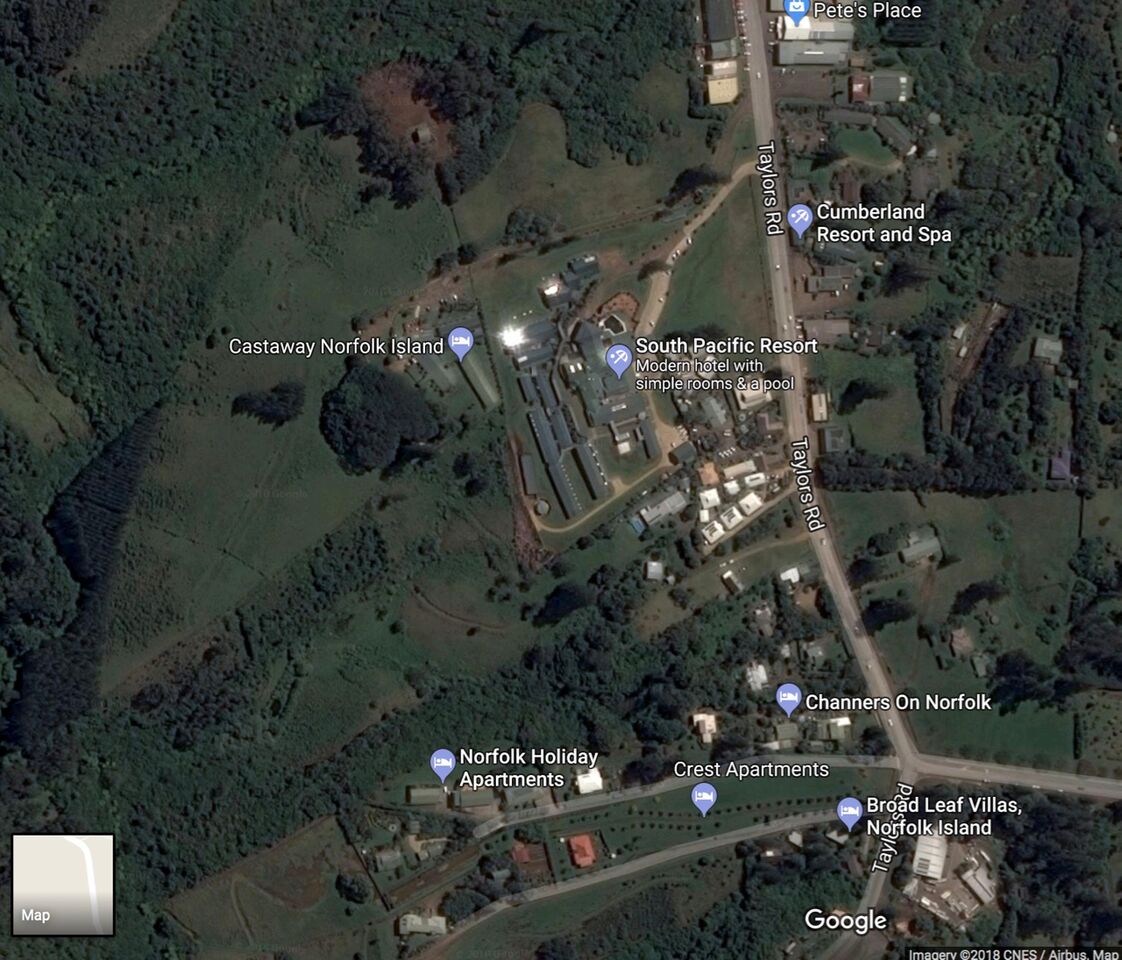 |
| Do not be confused with Google's signage of Cumberland Resort & Spa on the right hand side in Taylors Road. It is proof that Google is not always correct! Cumberland Resort & Spa was in fact on the left hand side of Taylors Road (middle one) and we stayed in the house with the orange roof. The driveway off Taylors Road (top one) to Castaway Norfolk Island gave us easy access to James Morrisby's property. |
 |
| Family walking on James Morrisby's land - Parcel 57. |
 |
| Darren on James Morrisby's land Parcel 57, looking to Parcel 61 far right hand side. |
 |
| Joy dwarfed by huge cluster of Morton Bay Fig trees on James Morrisby's land (probably about 200 years old). |
 |
| Adrian & Donna, Darren & Joy. |
 |
| Castaway Norfolk Island and large Norfolk Pine on Morrisby's land Parcel 57. |


 |
| Morton Bay Fig trees on James Morriby's land - Parcel 57. |
 |
| Sunset from James Morrisby's land. |
Memorial to "First Fleeters and Norfolk Islanders" in
St David's Park, Hobart.
A Memorial to the “First Fleeters and Norfolk Islanders” who came to Van Diemen's Island during the evacuation 1807 - 1813 was unveiled in St David's Park, Hobart in 1992. It records the names of James Morrisby, Ann Lavender Brooks, Grace, George, Dinah, Henry & John Morrisby. (no William Brooks). The family left Norfolk Island on 25 December 1807 and arrived Van Diemen’s Land 17 January 1808 on “Porpoise”. Richard Larsom is recorded as leaving Norfolk Island & resettling in Tasmania.There were mixed feelings as they had worked hard for nearly 20 years to support themselves. They had married and had children born on Norfolk Island, and now they had to start again. Darren and Joy went to Hobart in September 2017 and found the Memorial and the names of our convicts.
 |
| A Memorial to First Fleeters and Norfolk Island Convicts is in St David's Part, Hobart, Tasmania. |
 |
| This is our convict - James Morrisby & Ann Brooks. |
 |
| James Morrisby, wife Ann Lavender Brooks and 5 children - Diana, George, Grace, Henry and John arrived on "Porpoise" on 17 January 1808 as a result of being relocated from Norfolk Island to Van Diemen's Land. |
If you have any comments, corrections or additions to make, please contact the author of this blog, Joy Olney via email - joyolney@gmail.com


